When One Party Controls the Ballot, Are Voters Really Choosing?
Published: May 5, 2026
J.James: Opinion
South (Clinton) County Squawker
Local elections are designed to offer voters meaningful choices, but that dynamic can change under one-party dominance. In many rural counties, including Clinton County, the outcome is shaped well before the November ballot is set.
In Clinton County, Missouri, the most important local election may not happen in November. It may happen months earlier, in the dominant party’s primary — or even before that, when a small circle of party activists, candidates, donors, and local insiders decide who will run.
That is not a Republican problem or a Democratic problem. It is a competition problem.
For years, Clinton County leaned Democratic. Since the Trump-era realignment, the county has become heavily Republican. The party label changed, but the structural concern remains the same: when one party dominates local government, voters may end up with only one serious candidate on the final ballot.
Political scientists have studied this problem for years. Competitive elections are one of the main ways voters hold officials accountable. When races are uncontested or effectively decided in low-turnout primaries, public accountability weakens. A 2023 peer-reviewed article in Democratization describes uncontested elections as “silent elections” because voters are formally voting, but often without a meaningful choice.¹
Missouri law also makes the local party committee structure important. County party committees are built from precinct-level committeemen and committeewomen. Under Missouri statute, the man and woman receiving the most votes from each committee district become members of that county party committee.²
That means a small number of local party members can matter a great deal. They help shape the local candidate pipeline, influence party organization, and may become especially important when offices are vacant or when few candidates are willing to run.
The issue is not that political parties are illegal, improper, or unnecessary. Parties organize voters and candidates. But in a small rural county, one-party dominance can narrow the choice presented to the public.
The result is a familiar rural pattern:
The party primary becomes the real election.
The general election becomes a formality.
The average voter enters the process too late.
This concern is supported by broader research. Academic studies on one-party dominance in American states show that party competition affects turnout, policy, and political behavior.³ Research on primary elections also warns that primaries do not always substitute for meaningful general-election competition, especially when turnout is low or the electorate is narrow.⁴
So what can be done locally?
The realistic answer is not to “abolish parties.” That would require major legal changes and is not practical at the county level. But citizens can make the existing system more open.
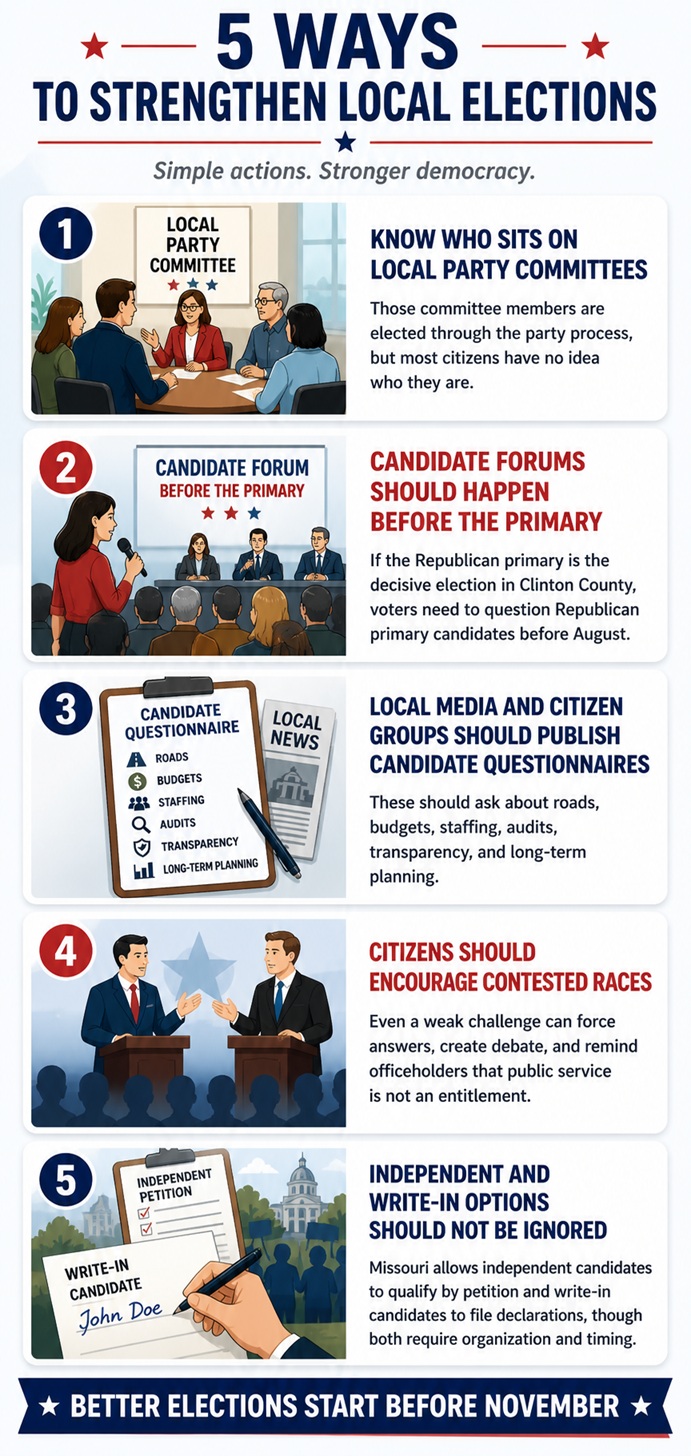
First, the public should know who sits on the local party committees. Those committee members are elected through the party process, but most citizens have no idea who they are.
Second, candidate forums should happen before the primary, not just before November. If the Republican primary is the decisive election in Clinton County, voters need to question Republican primary candidates before August.
Third, local media and citizen groups should publish candidate questionnaires for every county race. These should ask about roads, budgets, staffing, audits, transparency, and long-term planning.
Fourth, citizens should encourage contested races. Even a weak challenge can force answers, create debate, and remind officeholders that public service is not an entitlement.
Fifth, independent and write-in options should not be ignored. Missouri allows independent candidates to qualify by petition and write-in candidates to file declarations, though both require organization and timing.⁵
The goal should be simple:
More candidates.
Earlier public scrutiny.
More visible party committees.
Better-informed voters before the real decision is already made.
Clinton County does not need a revolution to improve its democratic process. It needs sunlight, competition, and citizens willing to pay attention before the ballot has already been narrowed to one name.
Footnotes
Email: cf385609@gmail.com
© 2025. All rights reserved.