How Does Clinton County Mo Government Work?
Notes on our county government. "The pieces of the puzzle"
Clinton County, Missouri, operates under Missouri’s standard statutory form of county government for third-class counties (no home-rule charter and no township organization). It is governed primarily by a three-member County Commission, with most major functions handled by independently elected “constitutional officers.” These officers are created by the Missouri Constitution and state statutes (primarily Chapters 49–55, 57–58, and 60 RSMo) and serve fixed four-year terms (elected in partisan general elections, staggered where applicable).
All elected officials are chosen directly by the voters of Clinton County and are independent of one another and of the County Commission. This is the classic Missouri “row officer” system designed to diffuse power.In other words - TO CHANGE COUNTY LEADERSHIP AND EFFECT CHANGE YOU MUST VOTE
Quick Additional Context on Overall Structure
County Commission = the central policy-making and fiscal authority for the county as a whole.
No hierarchy among row officers — they operate as co-equal elected officials.
Appointed or hired positions (not elected) include roles like the County Highway Engineer, Health Department Director, and various deputies/staff who report to one of the elected officers or the Commission.
Oversight mechanisms (beyond elections): Missouri State Auditor performs periodic performance and financial audits of the entire county (the one currently underway is one example); courts enforce compliance with state law; and state statutes set minimum duties and prohibitions.
County Commissioner Responsibilities core Statutory Duties (per Missouri law, as summarized in the 2022 State Auditor’s report on Clinton County)State law (primarily RSMo Chapter 49) defines
Regulating the use of county property by issuing orders or ordinances.
Approving the county budget (annually, with public hearings; they can also make later adjustments by formal vote).
Approving expenditures (reviewing and authorizing claims, bills, payroll-related items, and fund transfers).
Establishing policies for county employees.
Overseeing the construction and maintenance of county roads (often in coordination with the appointed County Highway Engineer).
Overseeing the maintenance of the county courthouse and jail.
These are the foundational functions that drive most of their regular work.
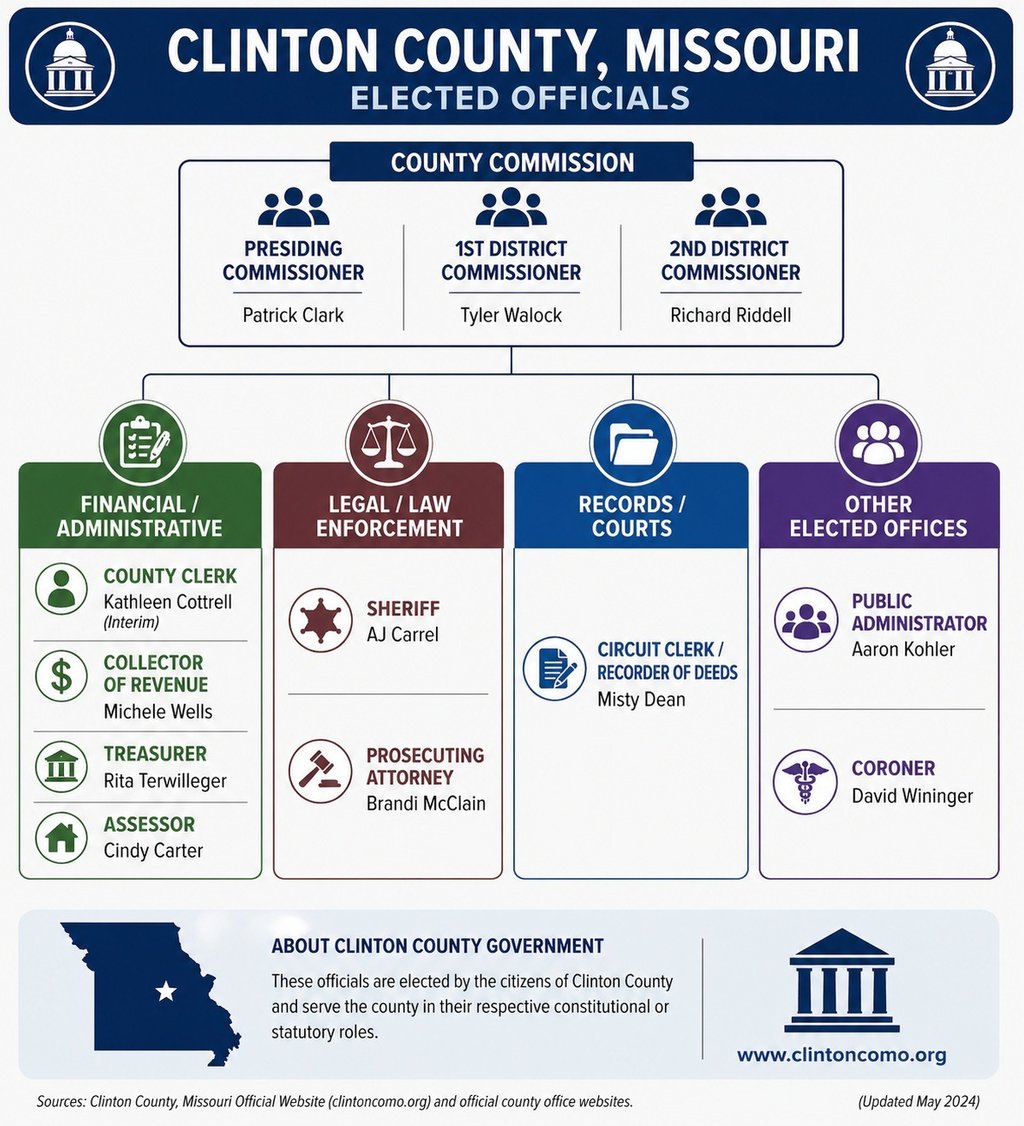
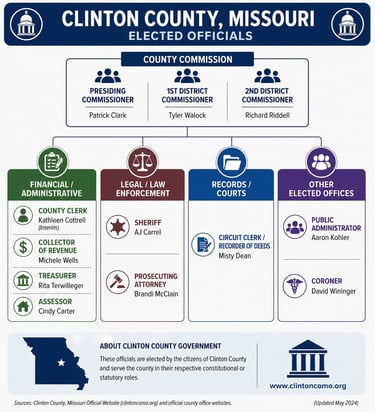
County Commissioners are elected on a staggered schedule. All terms are 4 years in duration. The Presiding Commissioner election is this year 2026. Election for the 1st and 2nd district commissioners will occur in 2028.
Updated May 1 2026
Squawker: HowTo Strengthen Local Elections
Email: cf385609@gmail.com
© 2025. All rights reserved.