The Clinton County Squawker
By Charles Ford
April 2026
Clinton County Compared: What the Numbers Say About Government Performance
In Clinton County, Missouri, frustration over roads, spending, and accountability has become a defining issue for voters. But how does the county actually stack up when compared to others across Missouri?
A review of population data, economic indicators, and government practices shows a clear pattern: Clinton County is not uniquely disadvantaged—but it is underperforming in key areas that are within its control.
A Middle-of-the-Pack County
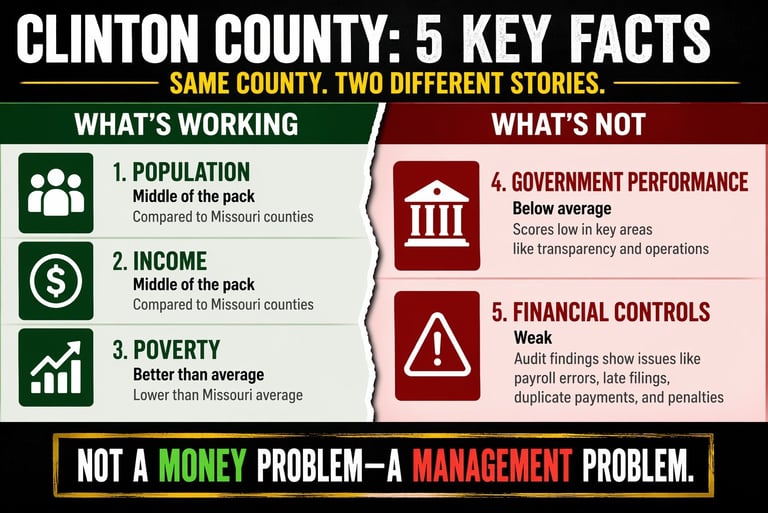
By the numbers, Clinton County sits near the middle of Missouri counties.
With a population of just over 21,000, it ranks roughly halfway among the state’s 114 counties. Household income is also near the state average, and poverty levels are actually lower than many parts of Missouri.
In short, Clinton County is not a struggling outlier. It has the resources and population base to operate effectively.
Where the Gap Begins
The differences emerge not in the economy—but in how government is managed.
Like most rural counties, Clinton operates under a traditional three-commissioner system. This structure is common across Missouri, but performance varies widely depending on how counties manage finances, planning, and operations.
Some counties—like Boone County, Missouri—have built strong financial systems, publish detailed reports, and maintain consistent oversight despite using the same basic structure.
Others, like St. Charles County, Missouri, have gone further by adopting a charter form of government, creating a full administrative structure with a county executive and professional departments.
Audit Findings Raise Concerns
In Clinton County, recent state audit findings point to deeper issues.
The Missouri State Auditor identified problems including payroll errors, late tax filings, duplicate payments, and avoidable penalties. These are not isolated bookkeeping mistakes—they are indicators of weak internal controls.
In well-run counties, systems are in place to prevent exactly these kinds of errors.
The Real Issue: Management, Not Money
The comparison makes one thing clear: Clinton County’s challenges are not primarily financial.
Counties with similar or even fewer resources are achieving better results through:
Stronger financial oversight
Clearer reporting
More structured planning
Better use of technology and training
The gap is not about how much money is available—it’s about how that money is managed.
A Path Forward
Improvement does not require a complete overhaul of government structure. Proven steps already exist and are being used successfully elsewhere in Missouri.
These include:
Publishing detailed, regular budget reports
Implementing stronger financial controls
Adopting data-driven road maintenance planning
Investing in training for county officials and staff
The tools are available. The question is whether county leadership will choose to use them.
The Bottom Line
Clinton County is not starting from behind. It is starting from average.
But in government, average performance—especially in financial management and infrastructure—can quickly lead to frustration when compared to what is clearly possible.
For voters, the choice is becoming clearer: continue with the status quo, or demand a more modern, accountable approach to county government.
The Clinton County Squawker will continue to examine county operations, spending, and performance as the election approaches.