The Clinton County zoning order establishes a structured and relatively sophisticated land-use system in which substantial final authority rests with the County Commission. The ordinance includes meaningful public-notice and protest procedures, but it also grants broad discretionary authority to county decision-makers. For citizens interested in local government, zoning may be one of the most important — and least understood — areas of county politics.
The Central Finding: The County Commission Holds the Real Power
One of the clearest findings in the zoning order is that the County Commission serves as the final decision-making authority for most major land-use matters. According to the ordinance, the County Commission has final authority over:
zoning text amendments;
rezoning requests;
subdivisions;
planned unit developments (PUDs);
special use permits;
and easement or right-of-way vacations.
The Planning and Zoning Commission primarily serves in an advisory role, reviewing applications and making recommendations before matters proceed to the commissioners for final action.
This means county commissioner elections may have far more influence over long-term land-use policy than many residents realize.
Signs of a County Dealing With Modern Land-Use Issues
The zoning order includes extensive sections involving:
solar energy systems;
marijuana cultivation and dispensaries;
confinement feeding operations (CAFOs);
communication towers;
industrial uses;
and subdivision regulation.
This suggests the county has gradually adapted its zoning system to deal with increasingly modern and potentially controversial land-use questions. The ordinance does not appear to be static or outdated. Rather, it appears to have been repeatedly amended over time.
A Particularly Notable Provision - CC Initiated Action
One section that stands out involves the ability of the County Commission to initiate zoning actions on its own. This means commissioners are not limited to simply responding to private rezoning applications. They possess the authority to proactively initiate zoning actions themselves.That authority is not improper — but it is politically significant.
Public Notice Requirements
The ordinance contains relatively broad public notice requirements. For rezoning matters, written notice must generally be provided to property owners within 1,000 feet of the affected property. Published notice in a newspaper is also required.In addition, the ordinance allows nearby property owners to file protest petitions. If a valid protest petition is filed, approval of the rezoning requires a two-thirds supermajority vote of the County Commission.Because Clinton County has only three commissioners, this effectively requires unanimous approval.This provision gives organized local opposition potentially meaningful leverage in controversial zoning disputes.
The Hearing Escrow System
Another unusual feature of the ordinance is the existence of a hearing-expense escrow system. If county officials determine that a zoning hearing is likely to exceed two hours, applicants may be required to deposit funds into a county-controlled escrow account to cover hearing-related costs.f additional deposits are not made when requested:
proceedings may be paused;
applications may be stayed;
and applications may ultimately be dismissed.
This type of hearing-expense system is more elaborate than many small rural county zoning systems.The ordinance itself does not explain why this mechanism was adopted.
Source: Clinton County Zoning Order (Amended 08-14-2025).
How Does Zoning in Clinton County Work?
The South (Clinton) County Squawker
Updated May 6, 2026
Author: Robert Ford
Opinion
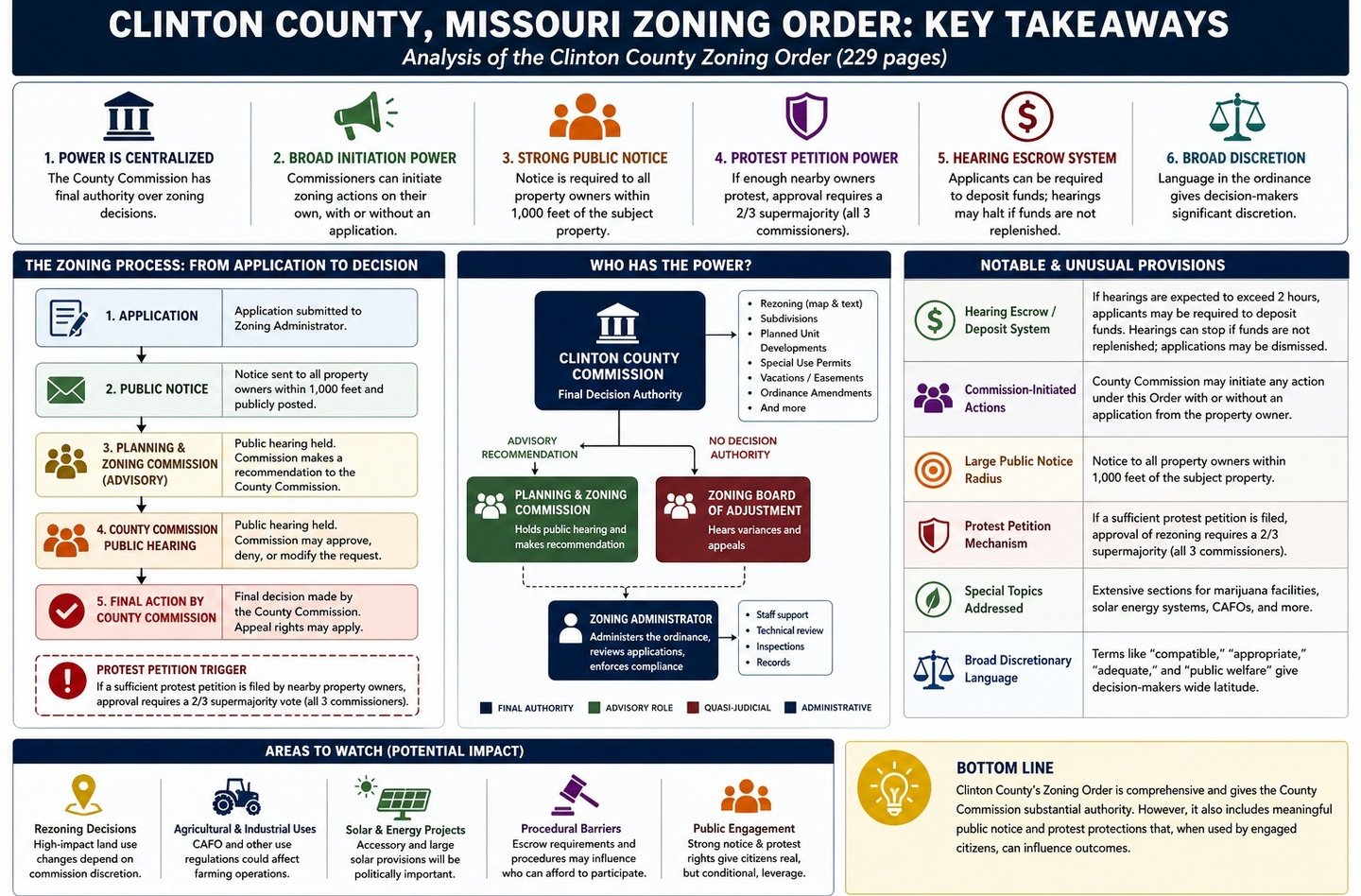
An analysis of Clinton County zoning laws reveals a county that continues to deal with modern issues and urban expansion, and reveals who has the real power when it comes to decisions.
Email: cf385609@gmail.com
© 2025. All rights reserved.