Clinton County has about 21,700 people, so the working-age, qualified, willing-to-serve pool is much smaller than the headline population.
The core problem
A county government needs people who can handle:
budgets
HR
procurement
road operations
law enforcement administration
legal compliance
grants
audits
public communication
technology
recordkeeping
But in a county of 20,000-ish people, you may only have a few hundred people with the right mix of education, experience, temperament, availability, and willingness to work in government.
Then shrink that again by asking:
Will they run for office?
Will they accept county-level pay?
Will they tolerate public criticism?
Do they live in the right district?
Are they politically acceptable locally?
Are they willing to work inside an old system?
That becomes a tiny pool.
Hiring only inside the county makes it worse
For some positions, local hiring makes sense. You want people who know the roads, residents, farms, towns, and local realities. But if a county informally limits itself to “people from here,” it can create a closed loop: same families, same habits, same assumptions, same politics, same skill gaps. That is especially risky for technical jobs: finance, grant writing, HR, IT, engineering, road planning, compliance, and administration. Those jobs need skills that may not exist locally in enough depth.
The pay problem
Counties compete against private employers, nearby cities, schools, state agencies, contractors, and larger counties. NACo notes that counties face recruitment and retention challenges, including difficulty competing with stronger compensation packages. BLS data also shows public-sector pay comparisons are complicated: government jobs may look competitive on average, but higher-skill professional roles often pay less than comparable private-sector roles.
So the county may need a skilled finance person, manager, mechanic, operator, or administrator — but the person who can do that well may have better options elsewhere.
The elected-office problem
Private organizations can hire a qualified manager. Counties often have to elect key leaders.
That means competence is filtered through:
name recognition
party politics
friendships
voter turnout
popularity
who is willing to run? - A capable manager may not want to campaign. A popular candidate may not be a capable administrator.
That is a structural weakness of small-county government.
The “one person wearing six hats” problem
Small governments do not have deep benches. One clerk, treasurer, road supervisor, or administrator may hold enormous institutional knowledge. If that person retires, quits, gets sick, or is simply not good at the job, the system has little backup.
National local-government workforce research continues to flag recruitment and retention as major public-sector problems, not just rural problems.
The Blunt Answer
For a county like Clinton County, the challenge is probably a mix of:
Small qualified labor pool
Low or uncompetitive pay for skilled roles
Local-only hiring habits
Elected leadership instead of professional management
Weak systems and documentation
Limited training pipeline
Low public scrutiny until something breaks
Rural culture that may value familiarity over credentials
The fix is not “find better people” by itself.
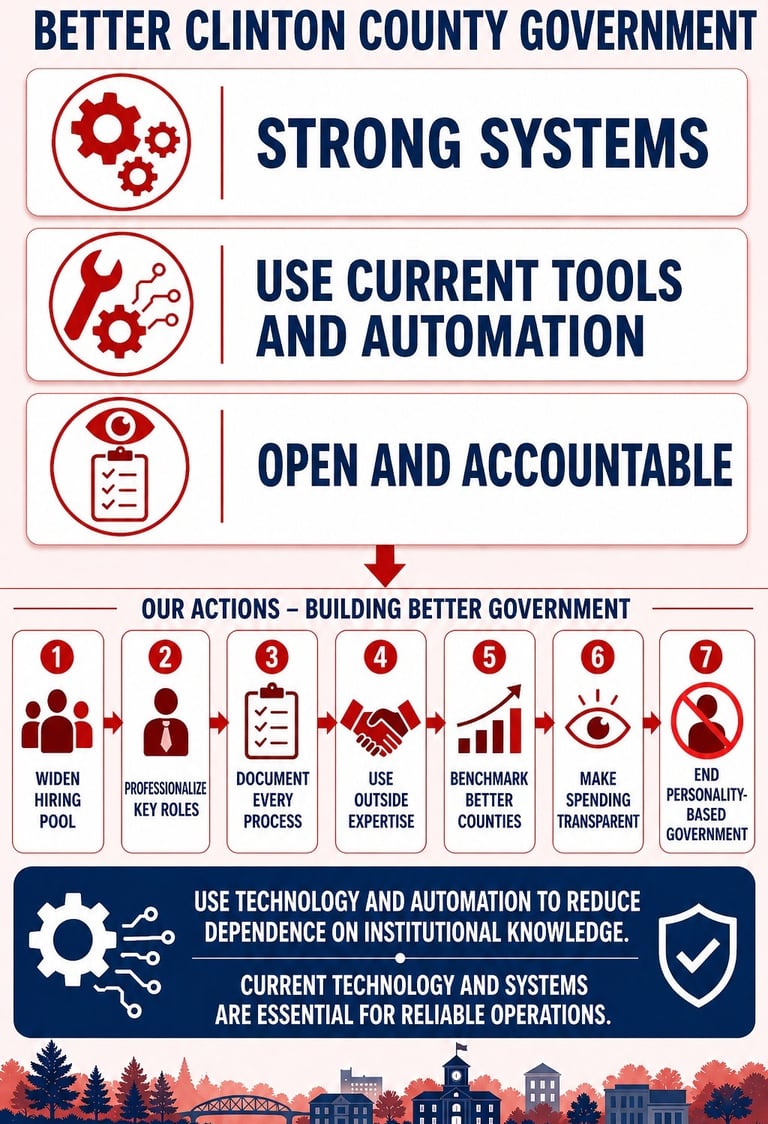
The fix is:
Widen the hiring pool,
Professionalize key jobs,
Document procedures,
Use outside training,
Benchmark against better counties
Stop relying on personality-based government.
Use automation wherever possible. This is essential in our high tech world.
Counties like Clinton County Missouri are not struggling because people are “dumb.” They struggle because the talent pool, pay scale, management structure, and political system are all small at the same time.
Why Does Clinton County Struggle with Basic Services?
Author: Charles Ford
Published: April 29
Opinion
South County Squawker
Email: cf385609@gmail.com
© 2025. All rights reserved.