The Road Money Is in the Bank. The Roads Are Not Fixed.
A three-county comparison of certified 2025 financial statements shows Clinton County spent a smaller share of its available road funds than its northern neighbors, spent more per mile of road, and ended the year sitting on $6.5 million in road cash.
Everyone running for office in Clinton County agrees on one thing: the gravel roads are in rough shape. Presiding Commissioner Patrick Clark has called the roads his "biggest pet peeve." His challenger, Linda Penrod, says mud and dust have gone from an inconvenience to a safety issue. Residents packed the Lathrop American Legion Hall on July 7 to say the same thing in stronger language.
So we went looking for the numbers. Not campaign claim but the actual certified financial statements every Missouri county is required by law to publish each year. We transcribed Clinton County's 2025 statement as printed in The Clinton County Leader on July 16, then did the same for two counties north of us: Nodaway and Daviess. Every figure below comes from those official documents or from the State Tax Commission's certified 2025 valuations, and every column cross-foots to the penny.
Here is what they show.
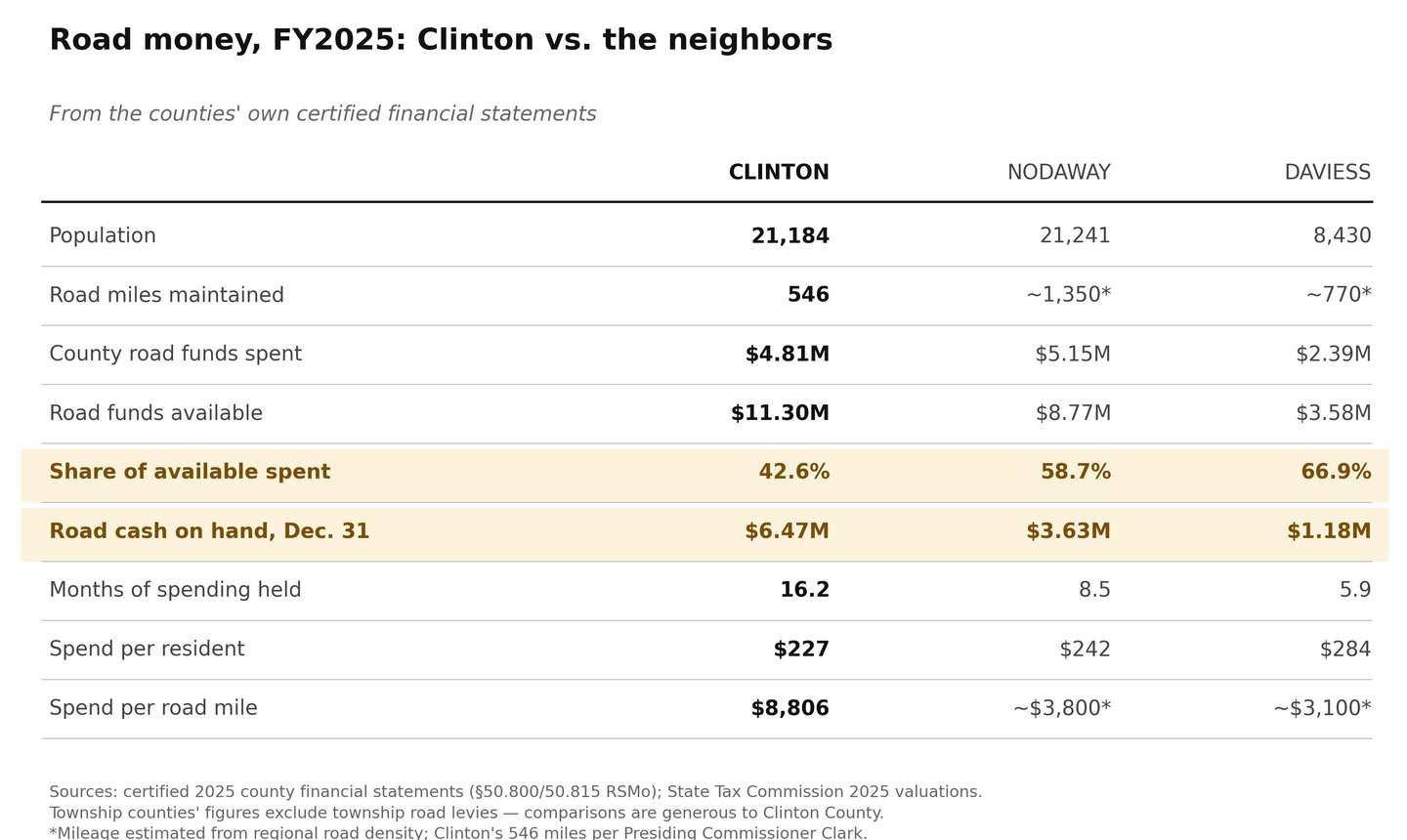
Clinton County spent $4.81 million out of its road funds in 2025 The Special Road and Bridge Fund plus the Capital Improvement Fund. That sounds substantial, and in absolute terms it is. But the same statement shows those two funds had $11.3 million available during the year: $6.09 million carried in from 2024 plus $5.2 million in new revenue. The county spent 42.6 percent of the road money it had.
On December 31, 2025, Clinton County's road funds held $6.47 million in cash, roughly sixteen months' worth of road spending at the county's own 2025 pace. While the county's 546 miles of gravel roads remained, in the presiding commissioner's own description, terrible.
Nodaway County has almost exactly our population, 21,241 people to our 21,184, spread across 875 square miles, more than double Clinton County's 423. In 2025 Nodaway's county road funds disbursed $5.15 million, more than Clinton County, out of $8.77 million available. That's 58.7 percent of available funds spent, and Nodaway ended the year holding about 8.5 months of road spending in reserve — half of Clinton County's cushion. Notable, too, is how Nodaway pays for it: its Special Road and Bridge Fund took in $3.2 million in intergovernmental money, fuel-tax distributions, state bridge cost-share and the like, against just $219,000 in property tax. They are aggressively pulling in outside dollars.
Daviess County is a third our size, 8,430 people. Its Road and Bridge Fund spent $2.39 million in 2025 out of $3.58 million available: 66.9 percent. It ended the year with less than six months of spending in the bank.
Per resident, Daviess spent $284 on county roads, Nodaway $242, Clinton County $227, the lowest of the three, before counting the township money our neighbors get on top.
Per mile, the gap is starker. Clinton County's $4.81 million across 546 miles works out to about $8,800 per mile. Neither Nodaway nor Daviess publishes a certified mileage figure, but their road networks can be estimated from road density in this part of the state, and under any reasonable estimate of their mileage, their county-level spending comes to roughly a third to a half of Clinton County's per-mile figure. Even taking the most conservative assumptions, the fewest possible miles for them, the most for us, the gap does not close. Our neighbors maintain far bigger road networks for far less per mile.
Let us be fair about two things. First, a road fund needs working cash: rock gets bought in season, winter revenue is thin, and state-matched bridge projects require the county to front money. Nobody serious argues the balance should be zero, but our neighbors run the same kinds of programs on reserves half to a third the size of ours. Second, Clinton County's overall road tax effort is not out of line: measured against the State Tax Commission's certified valuations, all three counties devote about the same share of their tax base to roads, 1.1 to 1.2 percent. This was never a story about Clinton County taxing too little. It is a story about Clinton County not spending what it collects, and about what a dollar buys here compared to twenty miles north.
There is also this. At the Lathrop Rotary Club in June, Commissioner Clark cited the growth of the county's emergency fund from zero to $1.2 million as a signature achievement, alongside ending every year in the black. Those are real accomplishments, the 2025 statement confirms both. But they describe a philosophy: money accumulated is treated as success. On the roads, money accumulated is the problem. Every dollar sitting in the Special Road and Bridge Fund on December 31 is a dollar of ditching, crowning and rock that didn't happen in 2025.
The candidates can debate whose plan fixes the roads. The certified numbers settle two narrower questions. Clinton County is not a county that can't afford to work on its roads, it banked more road money, relative to its spending, than any county in this comparison. And it is not getting more road for its money. It is getting less, per mile, than neighbors running larger networks through a supposedly clumsier fifteen-township system. Going into an election being fought over the condition of the roads, those are facts the courthouse should have to answer for.
Voters can draw their own conclusions on August 4.
Sources: Financial Statement of Clinton County, Missouri, FY ending Dec. 31, 2025, published pursuant to §50.800 RSMo in The Clinton County Leader, July 16, 2026; Financial Statement of Nodaway County, FY ending Dec. 31, 2025, certified April 1, 2026 (§50.815 RSMo); 2025 Financial Statement of Daviess County, certified May 22, 2026 (§50.800 RSMo); 2025 Missouri County Assessed Valuations as approved by the State Tax Commission, January 2026; candidate statements as reported in The Clinton County Leader, July 16, 2026; Clinton County road mileage per Presiding Commissioner Clark as reported in the Leader. Mileage for Nodaway and Daviess is estimated from regional road density; full transcriptions, calculations and methodology available on request.
The South (Clinton) County Squawker
July 19, 2026
Author: J. James
Opinion
Road and Bridge Spending
Email: cf385609@gmail.com
© 2025. All rights reserved.